Sophia Molina
Professor Lobell
Composition for Creative Expression
17.9.25
Artifact Analysis Essay
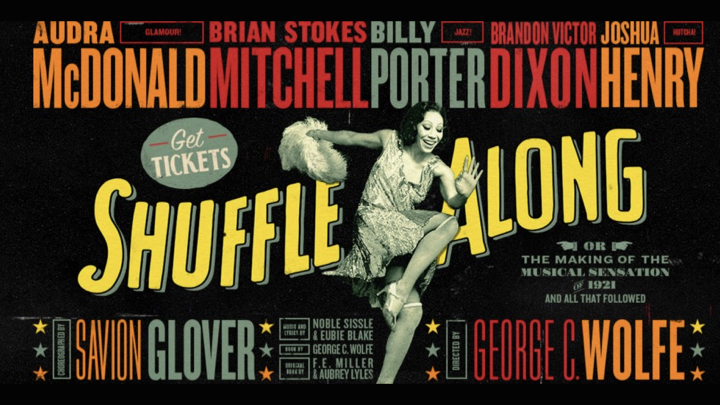
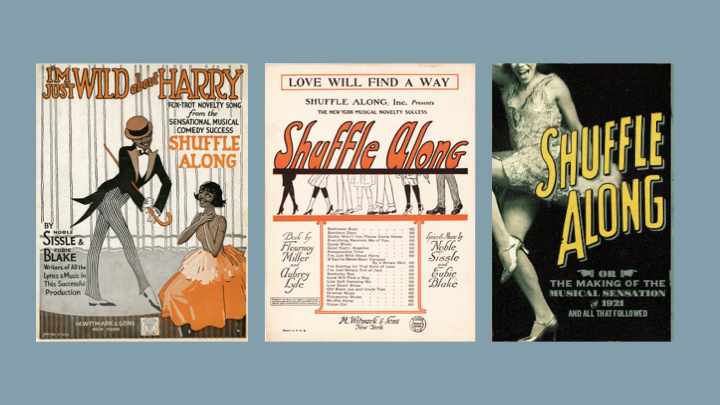
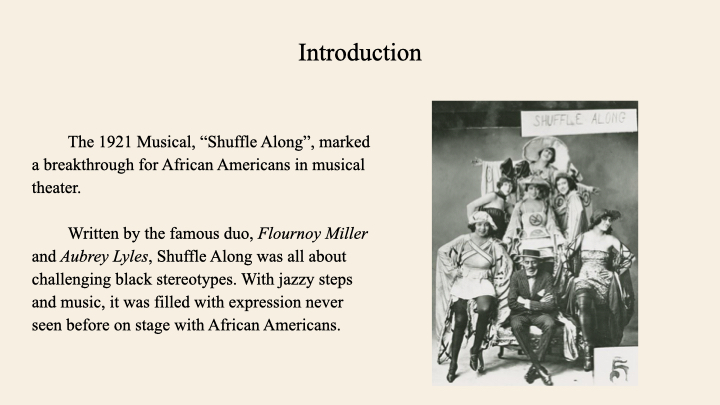
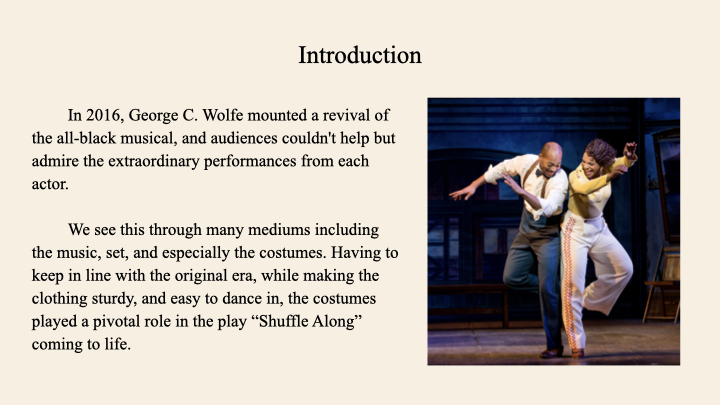
The 1921 Musical, “Shuffle Along”, marked a breakthrough for African Americans in musical theater. Written by the famous duo, Flournoy Miller and Aubrey Lyles, Shuffle Along was all about challenging black stereotypes. With jazzy steps and music, it was filled with expression never seen before on stage with African Americans. In 2016, George C. Wolfe mounted a revival of the all-black musical and audiences couldn’t help but admire extraordinary performances from each actor. We see this through many mediums including the music, set, and especially the costumes. Having to keep in line with the original era, while making the clothing sturdy, and easy to dance in, the costumes played a pivotal role in the play “Shuffle Along” coming to life.
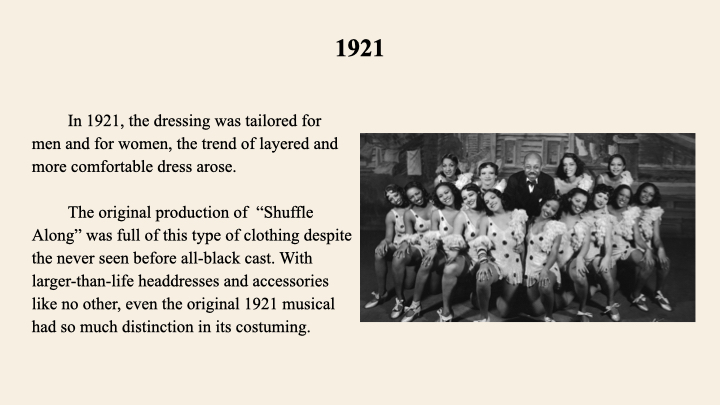
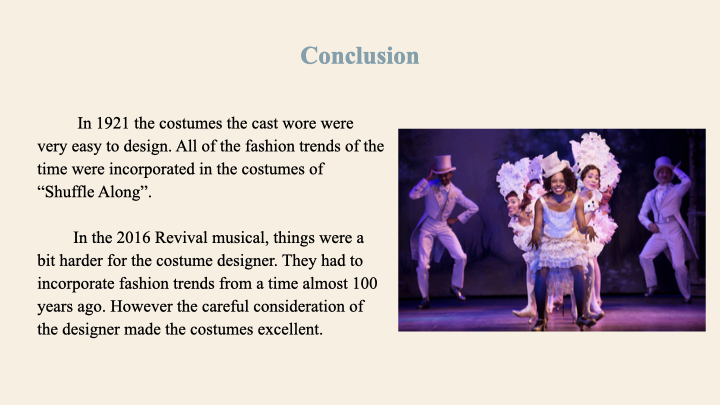
In 1921, the dressing was tailored for men and for women, the trend of layered and more comfortable dress arose. The original production of “Shuffle Along” was full of this type of clothing despite the never seen before all-black cast. It didn’t bring the cast down and in fact, promoted black excellence despite the racial stereotypes at the time. The actors were not only playing the part of a sophisticated performer, they also looked the part. With larger-than-life headdresses and accessories like no other, even the original 1921 musical had so much distinction in its costuming. The chorus girls for example wore long kimono-like outerwear with short dresses underneath. Their legs covered with stockings and their heads adorned with the largest headpieces you’ve ever seen. They were all so equally different yet cohesive when in its entirety. The whole of the cast was as such as well. All of them, so different but belonging to the same musical undoubtedly.
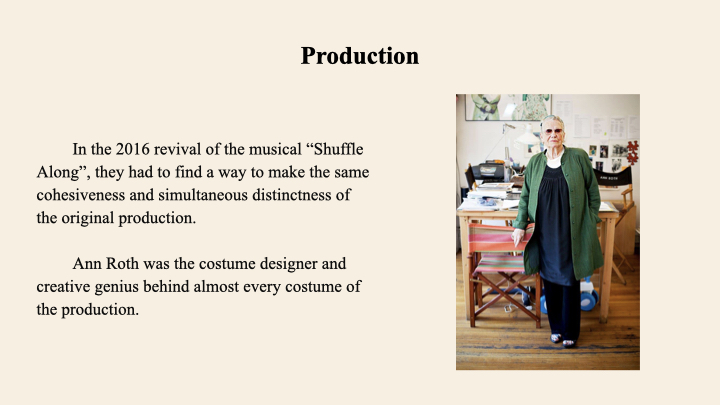
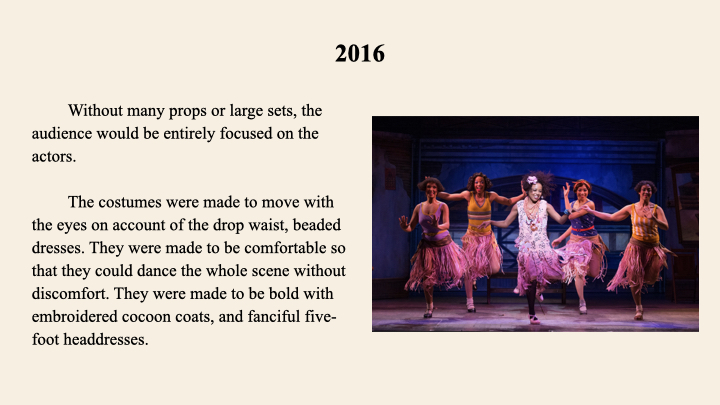
In the 2016 revival of the musical “Shuffle Along”, they had to find a way to make the same cohesiveness and simultaneous distinctness of the original production. Ann Roth was the costume designer and creative genius behind almost every costume of the production. She had to mix jazzy, bold, and 1920’s fashion in one. With “Shuffle Along” being such a performance-based musical, without many props or large sets, the audience would be entirely focused on the actors. The costumes were made to move with the eyes on account of the drop waist, beaded dresses. They were made to be comfortable so that they could dance the whole scene without discomfort. They were made to be bold with embroidered cocoon coats, and fanciful five-foot headdresses. They were also made to draw the audience in with bright bold colors on each actor respectively to give it a jazzy feel.
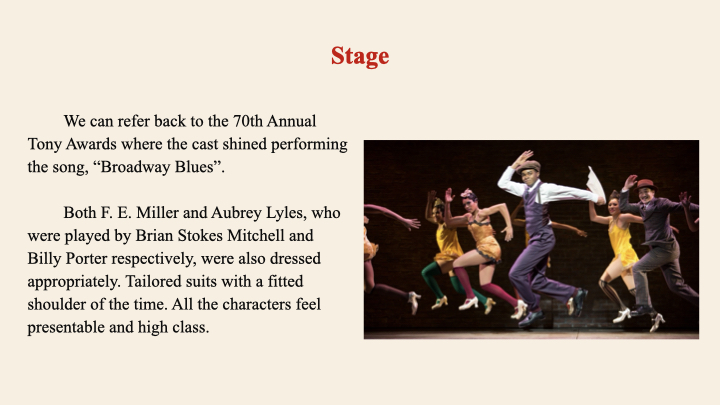
There are many such examples on the 2016 stage of “Shuffle Along” to refer back to in regards to the costumes but specifically in the 70th Annual Tony Awards where the cast shined performing the song, “Broadway Blues”. During this performance we see many of the main actors and they are all dressed in costumes that fit the time. An example would be Audra McDonald’s character, Lottie Gee, who wore a bright Royal Blue mid length dress with fringed edges and accessories. Her dress gave something the viewer could look at when she moved and it worked very well with her character. Both F. E. Miller and Aubrey Lyles, who were played by Brian Stokes Mitchell and Billy Porter respectively, were also dressed appropriately. Tailored suits with a fitted shoulder of the time. All the characters feel presentable and high class. The costume designer wanted to give this impression of the characters and as an audience member it’s one of the first observations. A well dressed character always has those types of assumptions by the audience. The characters and costumes were well received because of these facts.
To conclude the discussion on the various costumes of the musical production of “Shuffle Along”, we look back on the people who worked in them and their designs. In 1921 the costumes the cast wore were very easy to design. All of the fashion trends of the time were incorporated in the costumes of “Shuffle Along”. In the 2016 Revival musical, things were a bit harder for the costume designer. They had to incorporate fashion trends from a time almost 100 years ago. “Shuffle Along” was a historical musical by 2016 and to make the entire performance cohesive and immersive, the costume teams worked with fringe, mid length dresses, numerous accessories, bright colors, and etc. All to portray the time of 1921 and also give the musical setting accuracy. They made costumes also keeping in mind the jazzy setting and characters. The costumes were impeccable both in the 1921 and 2016 versions of “Shuffle Along” and many other historical musicals performed in the modern era should take note of the careful consideration of the costumes designers for “Shuffle Along”.
Sophia Molina
Professor Lobell
12/09/25
FIQWS 10113
Self-Assessment Essay
Self-assessment isn’t something I value heavily. I should take my own opinions into consideration and think about my work with different perspectives when no one else will but I don’t often do. Seeing an opportunity to think about my writing capabilities throughout the semester is interesting. I find myself thinking about my progress in my writing career and specifically in the goals of this class. This class speaks on how it will help you understand how to gather information accurately, evaluate sources and interpret them, write for different points of views using oral and written arguments, etc. This self-assessment essay is a way to figure out whether those things have changed in my writing from the beginning of the semester to now. Before writing individually on them, overall I would say, this class did its job. I see the progress in my writing and research between my essays and it is wonderful to know.
The first full essay I devised in this class was the Artifact Analysis Essay, featuring research about a production we had just learned about,”Shuffle Along”. We were given a total of 3 productions to choose from to write about, “Snow”, “Shuffle Along”, and “Rent”. The objective of the Essay was to analyze a part of the show and describe how it elevated the overall production. After choosing “Shuffle Along”, I chose to write about the costumes in the show. It did require some research between fashion trends in the 1920’s and the historical accuracies from the original production to the 2016 revival, however I would say I did wonderfully. I am biased to my own work however I did enjoy making it as much as I enjoy reading it. I’m proud to say I wrote about the topic with a well-educated outlook and well structured sentences. Despite this being the first full essay of the semester, to me it is not only my favorite but the best. Although the recent research essay was long winded and took a lot more time, it doesn’t necessarily make it better. Although it was hard to research something so niche as “The costumes in the 1921 and 2016 productions of Shuffle Along”, it was a very fun essay and I wouldn’t make any revisions. It might seem startling to believe in my own work so much, almost to an arrogant degree but I genuinely believe this essay is deserving.
In contrast to perhaps my best work of this class, we have my worst work of this class. The project itself wasn’t limited and instead promoted a lot of creative freedom between what you could do for it. I personally am an arts-driven person. I wanted to either make a physical artwork (poster, booklet) or I wanted to write something about the musical I chose with as much freedom as possible. I figured I would write a backstory for one of the characters in the work of, “Snow” and while others presented stories to a length that almost seemed an excerpt from a bigger text, I showed up with a measly synopsis. It wasn’t demanding, but I wasn’t thinking about the project as much as I should have. I didn’t think it was that valuable to me for this reason. I did so incredibly bad on this project that I actually didn’t get anything out of it. I did enjoy my actual story that I made for the character albeit, it was a bit dark, but it was something from my own mind so I won’t criticize it too much.
The most recent of my completed works in this class, the large Research Essay. Following an instructional teaching on picking a topic and writing 5 to 6 pages with synthesizing evidence and a multi-media element, I was a little scared. I’ve never done a research essay like this in my life. It was probably the most detailed writing assignment I’ve ever done. With seven cited sources, 2 peer-reviewed and all of them credible, I was struggling. I didn’t truly pick a topic for my own because I was absent for a few classes from being sick. This led me to try and catch up to my classmates but choosing a default topic my professor had posted. My topic was as follows; Articulate how meaning in the arts or communications is created and how experiences are interpreted and conveyed. I would later realize this default topic came from the syllabus, under ‘Goal of this course’. Not only was this a hard topic because of how broad it was, it was somehow niche enough for it to be a struggle to find supporting works. Despite me having immense trouble with this assignment, I think this is my second best work of the class. I would put it as first because of the sheer time and effort but the Artifact Analysis has more going for it than this. I think my research essay was very well done but there are some things I could have been better about. I wanted to get it done so badly and rushed it so much that I neglected things like, proper citation, relating evidence, and even making it somewhat easy to comprehend. For me the last bit wasn’t a problem because I know what I am writing however, to others, t might seem less than understandable. Even though I have much bas things to say about this essay, I’m am still whole-heartedly proud of it and i think it was the most valuable assignment for me in this class. Having to do extensive, and hard research papers now will only make me better in the future. In fact it is already a start that I know my shortcomings.
Going back to if this course was valuable, I would say yes. I don’t think I do or would see a drastic change in my writing because of this course but it has many takeaways. Looking back on all my work and analyzing it from an almost-unbiased point of view was eye-opening. Not only did I know what I did right, but also what I did wrong. I can give in the most illegible piece of writing in this class and be shown that because I know what bad writing looks like. Specifically what my bad writing looks like. Overall I think I achieved many goals of the course such as: gathering, interpreting, and assessing information or analyzing how arts from diverse cultures of the past serve as a foundation for those of the present, as well as describe the significance of works of art in the societies that created them. Particularly I’ve learned a lot about how to articulate how meaning in the arts or communications is created and how experiences are interpreted and conveyed. If i am asking myself how I think I did in this course, I would say well. I probably did the best in this class than any of my other classes. To me this class was a high priority for reasons I’m not privy to. I can’t deny this class had most of my attention. If I didn’t do well in this class, it’s safe to say I didn’t do well in my other ones. To give myself an arbitrary letter grade, I would say a ‘B’. I did have some lackluster writing so I don’t think an ‘A’ is in order but a B is still very good in my opinion. Being true to myself is different from being arrogant so I won’t downplay myself or my writing but instead be honest even if I come off as a little prideful.
Sophia Molina
Professor Lobell
11/10/25
FIQWS 10113
Research Essay
Topic: Articulate how meaning is created in the arts or communications and how experience is interpreted and conveyed.
The methodology of artists and their relationship to their art is complicated. Art is very individual and personal, meaning their message and experiences are all different. An artist will put meaning to their work based on their vision of it, and those visions are formed through an artists’ experiences. Artistic Expression, creative process, and overall artistic experience builds upon another to provide enough material to create something from nothing and having it mean anything at all. Using research analyzing many different artists and their visions, we can articulate how things like how meaning is created or how experience is interpreted and conveyed.
An artist can go through many changes in their lives. We can see phases of a person through their art. How does it change over time? We can already tell through time and experience, an artist will get better at their craft, however what about their style and message? Artists use art as a way of expression. How does their art change based on what they want to express? In Zitong Yang’s and Shou Yang’s, ‘Artistic Expression in Visual Communication Design in Multimedia Background’, it introduces this idea, “The characteristics of contemporary art visual elements are suitable for the design of visual communication. The integration of visual elements in contemporary art endows the visual communication design with a new image, because it needs contemporary ideas, contemporary forms, and contemporary communication media. “ (Yang) Newer ideas make artists create new works. Artists need new ideas to communicate through their art. To continue making progress through experience, as per the quote, artists need contemporary ideas. In other words they need new experience to make new visions for their work. Then those visions turn into the overall message of their artistry.
In a more direct approach to our question, we have an actual artist who talked about his specific artwork and how his experience shaped it. Artist, Henri Matisse who spoke on his work, ‘The Snail’. It is pictured below.
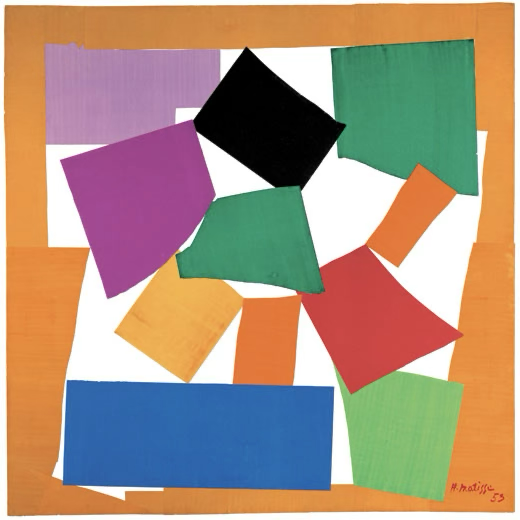
The actual artwork is gouache on paper, cut and pasted on paper mounted to canvas, from his cut-out series. The actual artwork is referred to as one of the best works in his entire career. The website refers here, “What stimulated his new series was having to succumb to a wheelchair after cancer. Confronted by physical limitations he was challenged to find another way to create art. He wrote, “I didn’t expect to recover from my second operation but since I did, I consider that I’m living on borrowed time. Every day that dawns is a gift to me and I take it in that way.”” (Phillips) To further discuss the work and the artists’ relationship to it, we look at what Mr. Matisse spoke about. Recovering and overcoming his cancer was something he didn’t expect to happen. He became inspired after his life or death experience. His world view changed and he realized everyday was a gift and made art in response to that. One of his best artworks was directly influenced by his experience. Not only did he give substantial written evidence to prove my claim but he is only a single instance of such things occurring. For an artist to be influenced by their experiences it doesn’t take cancer or a life or death situation. Artists get inspired by little and big things alike and each thing that happens to them influences their art in their own unique way. To discuss who different experiences can be interpreted by artists is another source describing their direct correlation. In the article named, ‘How Art Shapes Culture and Reflects Human Experience’ it states, “Art is a beautiful way to express feelings and thoughts. It allows people to delve into their emotions, transfer them to materials like paper or canvas, and then share their tales and sentiments with the rest of the world. Artists, regardless of medium, have a unique vocabulary that goes beyond words; it offers opportunities for capturing subtle thoughts and human experiences. ” (Ryna, 2023) Not only does the quote directly determine a relationship between culture, experiences, emotions and art, but it also delves into the actual mediums and messages between every artist. Describing how artists want to share a piece of themselves with the world and their pieces are expressed in their artwork. Their artwork is based on their emotions, and more importantly their experiences.
To decide whether the message even gets across to the observer, we have to become an observer. When looking at artwork and decoding it for a message, our own biases come into play. However this isn’t necessarily a bad thing because our experiences shape our perceptions of abstractness. To articulate this message, in a book on Philosophies named, ‘The Artistic Expression of Feeling’, it discusses, “The problem is that this tendency—even where the expressive content of a work of art is restricted to affective mental states and processes—has led to an unwarranted constriction of the topic of expression.” (Kemp, 315) To interpret this quote, we have to look back into ourselves. How do we view art personally? Why do we view art this way? Though it may seem like a bad thing when discussed in this quote. It is true that many people tend to have boxed-in opinions on art because we can’t think about it in the way the artist can or did. We think about expression and an artists’ message at all because we realize the simple fact that ourselves and the artists have different minds and the fact that we want to understand each other makes research begin. To further research on expression and an artists’ message, books such as, ‘The Creative Process’ by Marion Botella have come to be. In it they say this, “The artistic process begins with the conception of the artistic work. The work is introduced by an idea or a more or less vague impression. The second stage corresponds to the development of the idea . Artists structure, complete, and restructure the idea . Also, they identify the work development possibilities according to their ideas and feelings. “ (Botella, 59) Between interviews with artists and finding out how their brains work, the writer can state this almost as a fact. To create something out of nothing, you need to start, to start, think of an idea, then develop that idea, then think about this idea over and over again until your best work comes out of it. That is the artistic process, an inside look at an artists’ mind. It also is a clear tell of how an artists’ message can either be very broad or very specific. Depending on how broad or specific your initial idea is and how personal you want to make it, it all up to the artist. It reinstates the idea of individualism in art and how different everyone can be. How different they are is dependent on how they grew up, their experiences. An artist will form an idea based on what’s important to them, their work is something they want to speak about. What is important to you is based on your experiences.
When looking at artwork, people tend to firstly look at the aesthetics of it. Humans want to understand something more if it is ‘pretty’ or has a distinct style. Many artists choose to send messages to the audience while taking this fact into account. As stated in a journal article about this topic it describes, “Artistic examples that do not invoke aesthetic value include the majority of contemporary art from the 20th and 21st centuries (Kimball, 1997). Moreover, the ubiquity and popularity of art pertaining to negative emotions (Sachs, Damasio, & Habibi, 2015) and the intercultural differences in aesthetic perception (Marcus & Myers, 1995) preclude the identification of common mechanisms of the art experience that are based solely on aesthetic values.” (Rogala, 2020) This quote begins with the art aesthetics of the 20th and 21st centuries being devalued and tells of the realization of the artists’ experience is only told from an aesthetic standpoint. However this isn’t the only case for the audience. When viewed in a persons own lens, things can get more personal and art can elicit an emotional response based off your own experiences. In the same journal article it says, “Indeed, contemporary psychological investigations show that art can elicit both cognitive and emotional reactions (Silvia, 2006) and that understanding art can enhance an individual’s experience and enjoyment (Millis, 2001).” (Rogala, 2020) When understood, art tells very individual messages. Whether the artist had a broad message in mind or a specific personal message, they know every person who views it, will view it differently. They know each individual and even the artists’ own experience will shape how they look at an artwork. To relate to experiences affects on the creative process, in the article, ‘The impact of anger on creative process engagement: The role of social contexts’ it states, “There is growing recognition among researchers that employees’ affective experiences may influence employees’ CPE, an important precursor to creative outcomes” (Costa, 2017) CPE in this context is referring to ‘Continuing Professional Education’. Continuing Professional Education, ie: College, is an entire new world for many people. Often many artists, especially contemporary artists, were highly educated and shaped a lot of their work. CPE promotes new experiences at its core. In this quote, it’s essentially speaking on how experiences are an important need or precursor for creative outcomes.
So how do we articulate how meaning is created in the arts and how experience is interpreted and conveyed? Looking through the lens of both an artist and an observer is a start. Finding art that has meaning and wanting to find the meaning behind it, wanting to know why their meaning was important to them, enough so they would create something to discuss it. Researchers become fascinated with such things and use artistic expression, creative process and overall artistic experience to get closer to an artists’ vision. An artist will put meaning to their work based on their vision of it, and those visions are formed through an artists’ experiences.
Works Cited
Yang, Zitong, and Shuo Yang. “Artistic Expression in Visual Communication Design in Multimedia Background.” Mobile Information Systems, vol. 2022, Aug. 2022, pp. 1–10. https://doi.org/10.1155/2022/7954445.
Kemp, Gary. “The Artistic Expression of Feeling.” Philosophia, vol. 49, no. 1, Sept. 2020, pp. 315–32. https://doi.org/10.1007/s11406-020-00252-z.
Lubart, Todd. “The Creative Process.” Palgrave Macmillan UK eBooks, 2018, https://doi.org/10.1057/978-1-137-50563-7.
Da Costa, Carla Gomes, et al. “The Impact of Anger on Creative Process Engagement: The Role of Social Contexts.” Journal of Organizational Behavior, vol. 39, no. 4, Nov. 2017, pp. 495–506. https://doi.org/10.1002/job.2249.
Rogala, Jacek, et al. “A Hidden Message: Decoding Artistic Intent.” PsyCh Journal, vol. 9, no. 4, July 2020, pp. 507–12. https://doi.org/10.1002/pchj.374.
How Artists’ Life Experiences Change Their Art. manhattanarts.com/how-artists-life-experiences-change-their-art.
May, Ryna. “How Art Shapes Culture and Reflects Human Experience.” Humanities 101, pressbooks.howardcc.edu/humanities101/chapter/how-art-shapes-culture-and-reflects-human-experience.
Production: Snow
Write a short story giving a character a back story.
EMILY ADDAMS. A resident of Minnesota for all of her life. Aged 21, a Junior in the community college.
She was the youngest daughter of her large family of 7. She lived in a household with 5 siblings who were all older than her by at least 12 years. There was a disconnect between the siblings because of such a large age gap. She grew up basically as an only child, being raised entirely by her Grandmother because her actual parents didn’t have the time to raise a baby..
Despite her family circumstances she still thrived as a child. A creative and adventurous kid with aspirations and loving bonds. She especially liked the snow that fell heavily in Minnesota.
Snowball fights, maple syrup in the snow, snowman building. Emily liked to do it all with her grandma. Her fondest memories were made with her in the snow.
Until she was 16 when her Grandma died of natural causes. Her spark left her quickly. With her parental figure gone, she had no one to rely on. Her grades slipped and her perception of the world changed. She became bitter and cold. She hated the snow now.
Attending community college was her father’s decision. She could only get into community college with her horrible grades in the latter half of her high school years.
Her junior year she met an exchange student from Thailand who ignited her memories of snow. The girl from Thailand had an unusual fascination with snow, which was something the other had hated.
Emily realized then her meowed still cherished by her. She could appreciate the snow after opening up to the other about her memories. Her grandma and the snow were still in her heart.
Welcome to CUNY Academic Commons. This is your first post. Edit or delete it, then start blogging!

